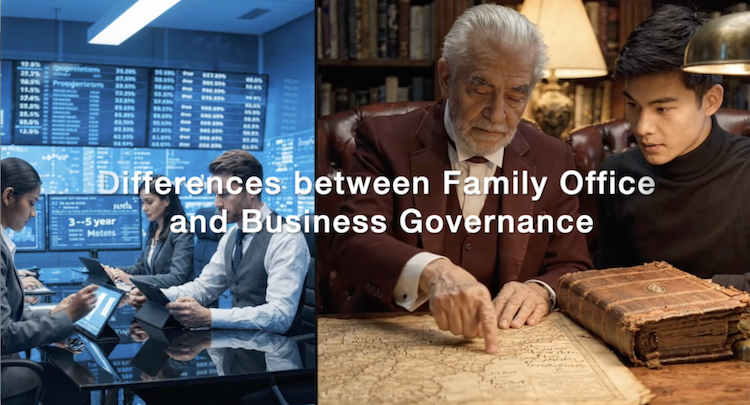
How does family office governance differ from business board governance?
Family office governance and traditional business governance operate on fundamentally different principles. While a business board prioritises shareholder returns and quarterly metrics, a family office board manages intergenerational wealth, legacy, and family harmony. The structures, time horizons, decision-making patterns, and emotional dynamics are entirely distinct. Understanding these differences is critical if you’re joining a family office board or advising family-controlled enterprises.
The Core Difference: Kingdom vs. Republic
Governing a traditional corporate business is like running a republic. It operates on meritocracy, structured cycles (quarterly earnings), and public accountability. Decisions follow formal rules. Shareholders can exit. Performance is measured against external benchmarks.
Governing a family office is like stewarding a kingdom. Power is concentrated. Decisions reflect dynasty, legacy, and long-term continuity. Shareholders are blood relatives. Success is measured by whether the family’s wealth and values survive generations.
This distinction matters because it changes everything about how governance functions. In a republic, you can remove a failing leader. In a kingdom, family bonds often override performance metrics.
Time Horizons: Generational vs. Quarterly
A traditional business board operates on a 3-to-5-year strategic cycle. Quarterly earnings drive decision-making. Investors demand returns within specific timeframes. Exits and acquisitions follow market windows.
A family office operates on a generational time horizon. Decisions are made for decades or even centuries ahead. The patriarch of a family office doesn’t ask “What will return profit in two years?” They ask “What will preserve and grow this wealth for my great-grandchildren?”
This fundamental difference explains why family offices can sustain long-term investments that public companies would never consider. They can plant oak trees knowing they won’t harvest them for a hundred years.
Decision-Making: Formal vs. Informal
In a traditional corporate board, decisions are made in the boardroom. There’s an agenda, minutes are recorded, voting happens formally, and decisions are final.
In a family office, real decisions often happen over Sunday lunch. The family matriarch voices an opinion. Siblings debate around the dinner table. A trusted advisor pulls the patriarch aside for a quiet conversation. The formal board meeting becomes a rubber-stamp exercise to confirm decisions already made.
This creates a governance structure that looks like a formal board on paper but functions more like an extended family council in practice. Independent directors sometimes discover they have little actual authority.
Succession Planning: Process vs. Emotion
Corporate succession is a structured, strategic process. An HR team identifies candidates. A nominating committee evaluates skills. The CEO is selected based on competence and strategic fit.
Family office succession is deeply emotional. It asks: Will my child respect what I’ve built? Can my sibling handle this responsibility? What happens if my cousin wants control but lacks the skills?
The stakes aren’t just financial. They’re about family harmony, legacy preservation, and whether relationships survive the transition. A failed succession in a family office can fracture family bonds for generations.
Control and Power: Diffused vs. Concentrated
A traditional corporate board distributes power among independent directors, the CEO, and management. No single person controls everything. Checks and balances exist formally.
A family office concentrates power in the wealth creator or controlling family members. Independent directors have influence only if the family permits it. The board can be disbanded if the family disagrees with its direction.
This power imbalance means independent directors must operate through influence rather than authority. You cannot force change. You can only advocate for it and hope the family listens.
Emotional vs. Rational Dynamics
Traditional boards make decisions based on data. A failing asset is divested. An underperforming executive is replaced. Logic prevails.
Family offices make decisions based on sentiment. A declining real estate portfolio might be protected because the patriarch purchased it decades ago and it represents his legacy. A family member in an unsuitable role might be retained to avoid conflict. Emotional attachment trumps commercial sense.
This isn’t weakness; it’s a different operating system. Family offices optimise for multiple variables: financial returns, family harmony, legacy preservation, and personal values.
Comparison Table: Family Office vs. Business Governance
| Governance Element | Family Office | Traditional Business Board |
|---|---|---|
| Primary Goal | Wealth preservation, legacy, family harmony across generations | Maximise shareholder value, financial returns, market performance |
| Time Horizon | Generational (50–100+ years) | Short-term (quarterly), medium-term (3–5 years) |
| Decision-Making Authority | Concentrated in wealth creator or controlling family | Distributed among independent board members |
| Where Decisions Really Happen | Informal (family dinners, private conversations) | Formal (boardroom, documented, structured) |
| Succession Planning | Emotional, family-based, often delayed | Strategic, merit-based, formally planned |
| Stakeholder Complexity | Family relationships, bloodlines, competing personal needs | Shareholders, employees, regulators, customers |
| Role of Emotions | Central to decision-making and governance | Minimised; logic and data drive decisions |
| Governance Flexibility | Highly flexible; family can change rules as needed | Structured and regulated; limited flexibility |
| Board Independence | Limited; family retains ultimate veto power | High; independent directors hold real authority |
| Asset Decisions | Driven by sentiment, legacy, personal attachment | Driven by financial performance and ROI |
Real-Life Story: The Barr Foundation’s Generational Shift
When Jim Canales joined the Barr Foundation as CEO, the board consisted of just himself and the two family founders, Amos and Barbara Hostetter. The family could have locked in permanent control. Instead, they made a remarkable decision.
They spent an entire summer in intensive conversations about how to evolve from a family foundation to a legacy foundation. They chose to dilute their own power intentionally. They decided the board would grow to 11–15 trustees, with non-family members holding the majority and structural control.
They explicitly chose not to restrict the foundation to Boston or require it to exist in perpetuity. Instead, they locked in only one permanent rule: the foundation’s core values of humility and curiosity.
This decision meant the founders relinquished control but ensured the institution would outlast their personal preferences and serve its mission better. That’s the opposite of typical family governance. Most families cling to control. The Hostetter family chose impact over dominance.
Real-Life Story: The Iceberg Beneath the Surface
An independent director joined a family mining company to help introduce modern governance practices. She noticed the company had vast unused buffer land around its mining facilities. She proposed building windmills to offset carbon emissions and create a new revenue stream.
The family’s first reaction: the idea was “out there” and unconventional. But instead of dismissing her, they listened. Within months, they had approved the wind project.
What changed their mind? She had spent months building relationships, understanding the family’s history, and earning trust. She wasn’t imposing an outsider’s logic. She was offering a solution that honoured the family’s long-term vision while solving a real problem.
The lesson: family office decisions aren’t made purely on merit. They’re made when the family believes the advisor respects their legacy and understands their values.
Real-Life Story: The Multi-Generational Transition in Washington D.C.
A 70-year-old family business faced a monumental governance challenge: transitioning from their second-ever CEO (a non-family member of 18 years) while simultaneously passing ownership from the second generation to seven cousins in the third generation.
The traditional business approach would be straightforward: hire a new CEO based on merit, implement modern governance structures, and hand over shares to qualified heirs.
The actual solution required deeper work. Advisors established a shared sense of purpose by asking: Do you genuinely want to own this business for another hundred years? Once the family confirmed they did, they built distinct governance structures using the “four rooms” concept: owners, board, management, and family.
They coached the older generation on how to step back. They assessed and coached an internal CEO successor. They taught seven cousins how to operate as joint owners without descending into factional conflict.
The transition succeeded not because governance structures were perfect on paper, but because the family invested in understanding each other across generational lines.
Real-Life Story: Meritocracy Over Entitlement
An Egyptian family-owned business required the founder’s son to go through an interview process that was actually more rigorous than what non-family candidates faced. He had to prove his worth. He couldn’t rely on his surname.
This sounds harsh, but it sent a critical message: capability matters more than bloodline. The son was ultimately appointed to a role suited to his actual skills, not simply seated next to his father because of his last name.
Most family offices struggle to maintain this standard. Entitlement creeps in. Underqualified family members occupy critical roles. The business suffers.
This family recognised that the greatest threat to multi-generational wealth is not market risk or competitive pressure. It’s the slow erosion of meritocracy. Once incompetent family members start running operations, the whole enterprise declines.
What to Look Out For When Joining a Family Office Board
The Invisible Decision-Making Structure
Before joining a family office board, you must discover where decisions actually happen. Ask directly: Does the formal board vote drive strategy, or are decisions already made before the meeting?
If real authority sits with the family patriarch in informal settings, your role as an independent director is severely limited. You become an advisor, not a governor.
Founder’s Syndrome and the Patriarch Override
The wealth creator often wants a board for legitimacy but not for challenge. They want advisors who validate their thinking, not disrupt it.
Before accepting a seat, assess whether the founder is psychologically ready to hear dissent. Do they genuinely want independent oversight, or just independent letterhead?
The Emotional Attachment to Assets
A family office may hold assets that are commercially underperforming but emotionally irreplaceable. A founder’s original building. A legacy investment. A family business that operates at a loss.
In a traditional business, you’d divest immediately. In a family office, these assets represent family history. You cannot simply recommend sale without understanding their emotional weight.
Generational Conflict and Sibling Rivalries
Adult family members often revert to childhood dynamics. An older sibling who was always dominant may still dominate the boardroom. A younger sibling desperate to prove themselves may push aggressively for change.
Think of it like an iceberg. The visible conflict at the surface is only 10% of the issue. Ninety percent lies below the waterline: decades of unresolved tensions, perceived slights, and competing needs.
The Succession Minefield
Family offices frequently delay succession planning because it forces hard conversations about mortality, control, and readiness. The founder may not want to acknowledge aging. Heirs may lack genuine commitment to the family enterprise.
Before joining, clarify: Is there an actual succession plan with named timelines and skill requirements? Or is succession a taboo topic everyone avoids?
At a Glance
| Family Office Governance Generational time horizon Concentrated power in family Decisions made informally Emotions central to strategy Succession based on family relationships Assets held for legacy, not ROI Board serves family vision |
Business Board Governance Quarterly/annual cycles Distributed board authority Formal decision processes Data and logic drive decisions Succession based on merit Assets evaluated on returns Board holds management accountable |
Director’s FAQ
1. Can an independent director actually influence a family office board if the family holds all real power?
Yes, but through influence rather than authority. Your value lies in asking difficult questions, providing external perspective, and building relationships with family members individually. Long-term credibility matters more than formal voting power. The best independent directors on family boards operate as trusted advisors who have earned the family’s respect over time.
2. How do I navigate the tension between my fiduciary duty and the family’s emotional attachments to assets?
Acknowledge both realities explicitly. A family office asset may be underperforming financially but overperforming emotionally. Rather than recommending immediate divestment, explore alternatives: Can the asset be restructured? Can it serve a dual purpose (legacy and return)? Your job isn’t to override emotion with logic. It’s to help the family make informed decisions with eyes open about the trade-offs.
3. What’s the biggest red flag when evaluating a family office board opportunity?
If the family says they want “independent oversight” but the founder makes all decisions unilaterally outside the boardroom, walk away. You’ll have liability without authority. That’s not governance; that’s theatre. Clarify upfront whether your voice will actually shape decisions, or whether you’re there purely for optics.
4. How do I raise difficult topics – like underperforming family members in leadership roles – without creating personal damage?
Build trust first, then raise the issue privately. Don’t ambush the family in a formal meeting. Have a quiet conversation with the patriarch or matriarch. Frame it around the family’s long-term success, not personal criticism. “Your son is a wonderful person, and his current role isn’t allowing him to succeed. What if we explored a better fit?” This respects both the person and the family’s values.
5. What distinguishes a functional family office board from a dysfunctional one?
A functional board has clarity on four things: (1) the family’s stated values and purpose, (2) where real decision-making authority sits, (3) how succession will happen and when, and (4) what topics are genuinely open for board debate versus non-negotiable family territory. Dysfunction emerges when these four elements are fuzzy, hidden, or constantly shifting. If the family can’t articulate their own governance rules, the board will operate in perpetual confusion.
Family office governance is deeply personal, emotionally layered, and fundamentally different from traditional business boards. Whether you’re joining a family office board, advising a family-controlled enterprise, or building governance structures for your own family wealth, the principles remain constant: understand the family’s true values, build trust before pushing change, and remember that legacy often outweighs returns.
If you’re navigating family office governance challenges or preparing to step into a non-executive director role, I’m here to help. Reach out to discuss your specific situation, access governance frameworks tailored to family offices, or talk through the real-world complexities you’re facing.
Andrew Seerden
Seerden Board Partners
[email protected]