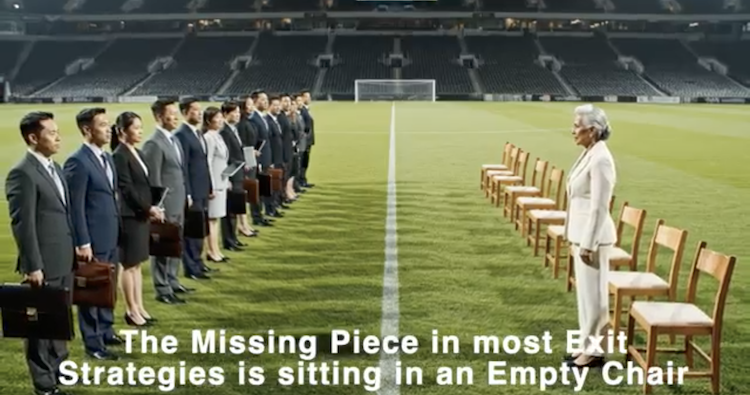
Is your business actually exit-ready?
Most businesses are not ready to be sold. Not because the numbers are poor, but because the right people are never in the room. Exit readiness is a structural reality. Only one in five businesses that go to market actually sell. Many are profitable, with customers, staff, and revenue. Yet they cannot transfer their value to a buyer. The reason sits in the Four C’s—the intangible capitals that account for up to 80% of business value.
Why most businesses cannot be sold
Strategic buyers are not purchasing your revenue. They are buying what your business will produce once they own it. They are buying your systems, your culture, your leadership depth, and your customer relationships. They are also buying confidence that all of that will still exist once the founder has left the building.
Research tells us that up to 80% of a business’s value exists in four intangible capitals:
| Capital Type | What It Means |
|---|---|
| Structural Capital | Systems, processes, and operational frameworks that exist independent of any individual. |
| Social Capital | Relationships, reputation, and trust within your market and customer ecosystem. |
| Customer Capital | Recurring revenue, retention rates, and the depth of customer relationships beyond any single contact. |
| Human Capital | Leadership depth, team capability, and the ability of the organisation to function without key individuals. |
If those four pillars are underdeveloped, a strategic buyer discounts the price or walks away entirely. The weakest link is almost always Human Capital.
If the wrong people are in the wrong seats, a buyer sees vulnerability. If the founder is the primary rainmaker, the primary product creator, and the primary decision-maker, the business is not an asset. It is a job. Buyers do not pay a premium for a job.
There is a straightforward test. Can you go on a six-month holiday and return to find the business stronger than when you left? Not just surviving—genuinely stronger. If the honest answer is no, the business is structurally dependent on you. That dependency is the single most common reason valuations disappoint or deals collapse.
What strategic buyers are actually looking for
The turnaround of Australian digital services firm ARQ Group illustrates this well. CEO Tristan Sternson inherited a publicly listed technology company under severe pressure. Stagnant revenue, low morale, and little market confidence. Rather than cutting costs and hoping for the best, Sternson treated it as a transformation. He reset the culture, demanded clear accountability, invested in capabilities that enterprise clients valued, and rebuilt internal trust from the ground up. He acted like an owner with a long-term stake, not a manager in decline.
Singtel’s NCS subsequently acquired ARQ Group for AUD$290 million—one of the largest technology deals in the Australian market at the time. That story illustrates what buyers reward: a business that runs on systems, leadership, and culture rather than on the founder’s daily involvement.
Netflix versus Blockbuster tells a related story. Netflix identified an unmet customer need—on-demand viewing without punishing late fees—and built the entire business around solving it. Blockbuster focused on protecting a profitable existing model and arrogantly declined an early offer to buy Netflix for just $50 million. Netflix used data and personalisation to compound its customer advantage. Blockbuster did not adapt.
The businesses that attract strategic buyers obsess over the customer and build scalable systems. The businesses that repel buyers protect yesterday’s revenue model.
Strategic buyers also apply what M&A advisors call the “hit by a bus” test. If the founder was unavailable tomorrow, would the business continue to function? If the answer is no, buyers apply a significant discount for key person risk. Or they walk away and look for a better-structured asset elsewhere.
AI fluency and the electricity moment
There is a powerful analogy in the research on AI readiness and business valuation. When factories shifted from steam power to electricity, some operators simply swapped a gas lamp for a light bulb. Minor gains, nothing transformational. The real value came when leaders completely redesigned the factory floor around the capabilities of the new power source.
In business today, strategic buyers increasingly look for AI Fluency in the leadership team. Less than 6% of CEOs at the world’s largest companies have a technology background. Only 8% possess a strong working knowledge of artificial intelligence. Buyers see that as a strategic risk embedded in the leadership structure.
This does not mean every business needs to be a technology company. It means the leadership team needs to understand how AI affects your market, your operations, and your customers—and be actively making decisions that reflect that understanding. Buyers are acquiring your future capability as much as your current performance.
An advisory board is your exit team
Return to the football field analogy. The difference between a strong exit and a disappointing one often comes down to preparation and the quality of the team you have around you well in advance.
A Growth Advisory Board brings an experienced, practised team onto the field alongside you. Not to run the business on your behalf, but to provide the outside perspective, commercial challenge, and strategic accountability that most internal leadership teams cannot provide each other.
In practice, that means an effective advisory board helps you identify and close governance gaps before a buyer finds them. It builds the leadership depth that reduces key person risk. It stress-tests your strategy before the market does. It brings external credibility to your business at precisely the moment buyers are evaluating whether your leadership team is capable of scaling under new ownership.
The commercial case is supported by data from the Advisory Board Centre. Businesses with a properly structured advisory board report a 24% increase in annual sales, an 18% boost in productivity, and a 15% improvement in financial performance. Business owner confidence increases by 30%. Advisory board adoption has risen by 52% since 2019.
The investment is modest relative to the return. A well-run advisory board typically costs between $40,000 and $70,000 NZD per year. That is 50–70% less than hiring a full-time senior executive, yet it brings the depth of a practised team with diverse experience across sectors and markets.
Build for the buyer you have not met yet
The most consistent theme across the research is straightforward. Businesses that attract strategic buyers are built that way years in advance, not months before the sale process begins.
Exit readiness is not a sprint. The Four C’s take time to develop. Leadership depth takes time to build. Financial discipline, recurring revenue, operational clarity, and governance structures all require a three-to-five-year runway to be credible under a buyer’s scrutiny.
The founders and CEOs who achieve the best outcomes do not treat exit preparation as a separate project. They treat it as the way they run the business. They make decisions today that a future buyer will respect. They build systems that outlast their daily involvement. And they surround the leadership team with advisors who have been where the business needs to go.
A Growth Advisory Board will not guarantee a successful exit. Nothing does. But it closes the preparation gap that leaves most businesses either undervalued or unsold.
If you are a founder or growth-stage CEO who wants to build a business that is genuinely worth acquiring, or if you are ready to establish a Growth Advisory Board and want an experienced Chair or independent advisor at the table, I welcome the conversation.
Reach out directly at [email protected].
Andrew Seerden is a commercial strategist and Growth Advisory Board facilitator. He works with founders and executive teams to build strategic advisory structures that drive measurable growth and exit readiness. Seerden Board Partners provides advisory board design, governance, and strategic oversight for B2B businesses across New Zealand.
This article was originally published on LinkedIn.
View the original discussion here.