Why is strategy not a plan?
Strategy and planning are not the same thing. Strategy defines where the business is going and why. Planning determines how it will get there. One sets direction. The other allocates resources. Confuse the two, and a company executes brilliantly on the wrong thing. Get them right, and the business builds the agility to thrive through volatility.
The Cobra Effect: when good plans create bad outcomes
Under British colonial rule, Delhi had a cobra problem. The government offered a bounty for every dead snake. Pay money, get fewer cobras. Simple plan, linear logic.
Locals started breeding cobras to claim the bounty. When officials cancelled the scheme, breeders released their now-worthless snakes into the wild. Delhi ended up with more cobras than before.
This is planning without strategy. The plan followed an A-to-B sequence. Strategy demands a different question: what happens after our plan succeeds? Planning assumes a predictable world. Strategy prepares for an unpredictable one.
How did Blockbuster miss Netflix?
Blockbuster had the chance to buy Netflix. They turned it down. The streaming model sat outside their operational thinking. They were focused on the existing plan: physical stores, late fees, video rentals.
Their true strategic purpose was entertaining customers. They thought it was renting cassettes.
Netflix understood the difference. Reed Hastings built three companies inside one. He moved from mailing DVDs to streaming, then to creating original content. Each shift required strategic pivots, not better plans. Planning would have kept Netflix mailing DVDs more efficiently. Strategy transformed the entertainment industry.
What does the Kodak collapse teach us?
Kodak invented the digital camera. Their own patents killed them.
A strategic view would have compared the long-run cost of chemicals against the cost of computing. Once computing dropped below chemicals, the market would flip. By the time it did flip, planning a response was too late. The strategy needed to be in place ten years earlier.
Kodak failed because they confused their planning cycle with their strategic horizon. Planning runs on quarters and budgets. Strategy runs on decades.
How Amazon’s strategy outlasted its planning
Jeff Bezos held a strategic line ten to fifteen years into the future. In the early days, shipping costs outweighed book costs. On a spreadsheet, that looked like bad planning.
Bezos was not optimising for quarterly profitability. He was building infrastructure. That infrastructure became Amazon Web Services, now one of the most profitable businesses on the planet.
If Amazon had stuck to traditional planning based on quarterly returns, AWS would never have existed. It had no direct relationship to the core e-commerce model at the time. Planning would have killed it. Strategy created it.
Branches and sequels: what military doctrine teaches business
A retired Major General once explained the principle: no plan survives first contact with the enemy. Military doctrine separates the plan, which is the initial document, from strategy, which is the discipline of recognising triggers that force you onto a different track.
The military calls these branches and sequels. In business, think of them as on-ramps and off-ramps. The discipline is whether leadership can shift direction based on real conditions, rather than locking into the original script.
The rugby analogy: attack and defend at the same time
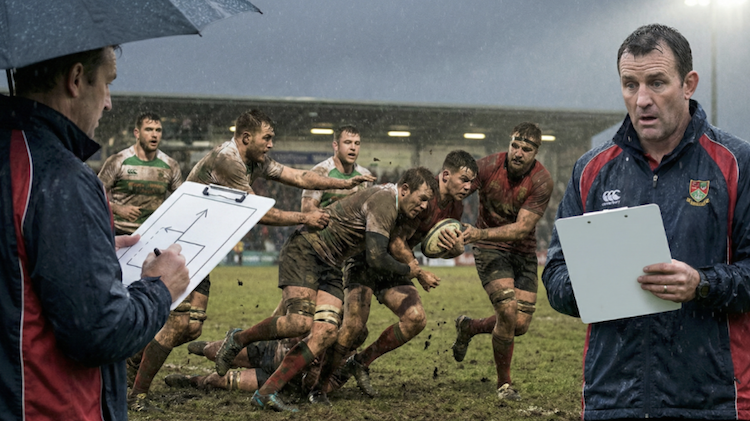
Strategic agility works like a rugby match. You cannot plan to attack for the entire game. You attack. Thirty seconds later you defend. Sometimes both at once.
Strategy is the agility to switch modes instantly based on conditions. Planning assumes the team knows in advance which mode it needs. In a volatile market, that assumption fails.
The ship and the helicopter: where strategy actually lives
One way to picture the difference. Planning is being on a ship, fixing a small leak, painting the side. The focus is keeping the vessel running.
Strategy is being in a helicopter five kilometres above. From that height, the torn sail does not matter. The iceberg dead ahead does. The question becomes whether the entire course needs to change.
Planning looks six feet ahead. Strategy looks six months, six years, sometimes six decades ahead.
How does strategy differ from planning?
The two disciplines work on different time horizons, answer different questions, and live in different parts of the organisation. The table below sets out the practical contrast.
| Dimension | Strategy | Planning |
|---|---|---|
| Core question | Where are we going and why? | How and when do we get there? |
| Primary output | Choices, trade-offs, hypotheses | Budgets, timelines, milestones |
| Time horizon | Years to decades | Weeks to quarters |
| Focus | Weak signals on the edge of the radar | Clear and present priorities |
| Response to change | Adjusts direction | Executes the chosen path |
| Owned by | Board and CEO | Management and operations |
| Lives in | Conversation | Documents |
| Failure mode | Vague intent without execution | Brilliant execution of the wrong thing |
Why this matters for business growth
Research shows organisations with effective advisory boards see a 24% increase in annual sales, an 18% boost in productivity, and a 15% improvement in financial performance. These results do not come from better planning alone. They come from strategic clarity.
A Growth Advisory Board brings external perspective. It creates space for the strategic conversations that daily operations crowd out. It provides accountability for moving beyond planning into genuine strategic thinking.
The “noses in, fingers out” principle applies. Good advisors provide strategic oversight without operational interference. They ask the uncomfortable questions. They spot the freight trains on the radar’s edge. They help leadership tell the difference between fixing the old car and buying a new one.
Making the shift
Start by asking: is the leadership team spending most of its time on the “how” or on the “what and why”? Are board meetings consumed by reports about the past, or by discussions about the future?
Strategy is not a document written once a year. It is an ongoing conversation about direction, trade-offs, and choices. Strategy is about conscious decisions that shape the future direction of the business.
Planning follows from that conversation. Not the other way around. Planning mobilises the organisation to convert strategy into action.
The businesses that thrive through volatility are not the ones with the most detailed plans. They are the ones with the clearest strategy and the agility to adapt their plans as conditions change.
Director’s FAQ
What is the difference between strategy and planning?
Strategy defines where a business is going and why. Planning determines how it will get there. Strategy sets direction and scans for change. Planning allocates resources and executes the chosen path. Both matter, but strategy must come first.
Why do companies confuse strategy with planning?
Most leadership teams operate in execution mode. They make decisions on the run. Planning feels productive because it produces visible artefacts: budgets, timelines, milestones. Strategy is harder. It requires sitting in ambiguity and asking uncomfortable questions about direction. The bias toward action drives most teams to skip the strategy step and call their plans strategy.
How can a board tell whether the company has a real strategy or just a plan?
Look at where the leadership team’s attention sits. If meetings focus on past performance and operational reports, planning is dominant. If meetings include open discussions about market shifts, competitor moves, and the question “what if we are wrong about our core assumption?”, strategy is alive. A real strategy survives questioning. A plan dressed up as strategy collapses under it.
What role does an advisory board play in strategic thinking?
An advisory board brings external perspective without operational entanglement. It creates the space and accountability for strategic conversations that daily operations crowd out. Effective advisory boards challenge assumptions, surface weak signals on the edge of the radar, and hold the executive team honest about whether they are working on the right things, not just doing things right.
How often should strategy be reviewed?
Strategy is not an annual exercise. It is a rolling conversation. Major shifts in market conditions, customer behaviour, technology, or competitor activity should trigger a strategic review. Quarterly strategic check-ins, with a deeper annual reset, work well for most B2B businesses. The cadence matters less than the discipline of separating strategic conversations from operational ones.
Sharpen the strategic conversation in your business
If you lead a B2B business through volatility and want a clearer separation between strategy and planning, a Growth Advisory Board provides the external perspective and accountability the executive team cannot generate alone. Beyond Growth Advisory Boards, Seerden Board Partners works with founders, CEOs, and boards on advisory board design, chair effectiveness, and CEO and founder counsel.
To explore whether strategic advisory support fits your situation, email Andrew Seerden at [email protected] or visit seerdenboardpartners.com.
About the author
Andrew Seerden is the founder of Seerden Board Partners, a board advisory practice based in Auckland working with B2B businesses across New Zealand and internationally. The practice focuses on commercial growth oversight, advisory board design and chair effectiveness, and CEO and founder counsel. Andrew brings 30+ years of senior commercial leadership at IBM, Compaq, and Hewlett-Packard, alongside 11 years chairing StarJam Trust.
This article was originally published on LinkedIn.
View the original discussion here.