How does a Chair build psychological safety at board level?
Most boards only hear what the CEO wants them to hear. A Chair fixes that through structure, culture, and deliberate behaviour, not conflict. Psychological safety at board level is the set of conditions that allow executives to share critical information, including when that means going past the CEO. It rests on six mutually reinforcing categories: structural mechanisms, cultural approaches, relational approaches, meeting processes, behavioural signals, and governance principles.
Why goodwill alone is not enough
A polite board is not a safe board. Polite boards reward concealment because difficult news creates discomfort. Safe boards reward truth-telling because difficult news creates options.
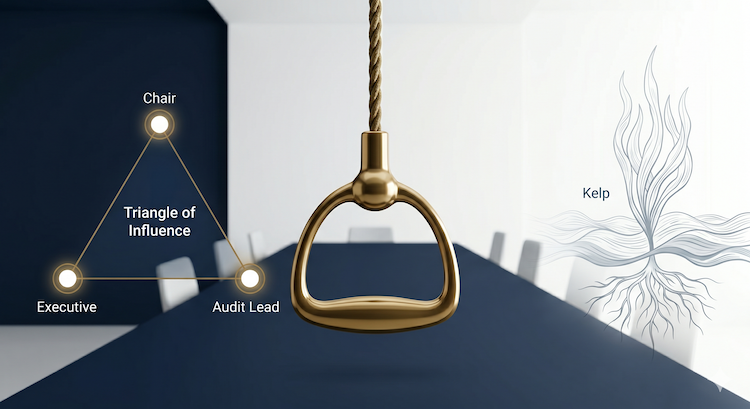
Structure carries the weight when goodwill runs out. Independent reporting channels, a Triangle of Influence between the Audit Chair, CFO, and Head of Internal Audit, and Andon Cord authority give executives a legitimate route to the board that does not require CEO permission. None of this is hostile to the CEO. It is normal governance hygiene.
Ready to test the presence of psychological safety at your organisation?
Complete our free Psychological Safety Assessment, and you will receive an objective comprehensive breakdown of your board’s performance across six critical pillars – including Structural Safety, Strategic Alignment, and Risk Integrity.
This data-informed insight allows you to identify exactly where “politeness” is rewarding concealment and where your reporting lines might be choking.
Culture decides whether truth travels
Even with the right structures in place, executives stay quiet if the culture punishes the messenger. Bad News by Rocket, Good News by Rickshaw makes the principle explicit: the sin is concealment, not the problem itself. Treat all-green dashboards with suspicion. Silence is rarely a clean signal. More often it means people are afraid.
The Mushroom Theory captures the failure mode. Directors kept in the dark and fed curated highlights cannot govern. Demand raw data, unedited surveys, and analysis of shortcomings. Reject the comfortable version.
Behaviour sets the ceiling
Executives read the Chair’s reactions before they decide what to say. The Kelp Exercise, taught by seasoned Chair Maggie Wilderotter, captures the discipline. Kelp gets battered by surf yet stays rooted. When bad news arrives, stay centred. Listen without a knee-jerk reaction. Thank the messenger publicly. Ask the room how to help.
The Clean Question closes every meeting. Ask presenting executives, “Was there anything you wanted to say that you didn’t have a chance to say?” One question. It grants permission to surface what the CEO narrative left out, without anyone having to engineer the moment.
The six categories compared
| Category | What it fixes | Example approach |
|---|---|---|
| Structural mechanisms | Information flow blocked by hierarchy | Triangle of Influence; Andon Cord authority |
| Cultural approaches | Politeness culture that punishes truth | Bad News by Rocket; Yellow Card system |
| Relational approaches | Lack of trust between Chair and executives | Trifecta of Trust; Walk Arounds |
| Meeting processes | Curated presentations that hide risk | Clean Question; demand inputs, not outputs |
| Behavioural signals | Chair reactions that punish messengers | Kelp Exercise; the Clapping Moment |
| Governance principles | Ambiguity that protects bad behaviour | Noses In, Fingers Out; clear decision rights |
Director’s FAQ
What is psychological safety at board level?
It is the set of conditions that allow executives to share critical information with the board, including information the CEO would prefer to filter or delay. Safety here means freedom from career penalty for telling the truth. It does not mean comfort.
Does an executive bypassing the CEO undermine governance?
The opposite. A dysfunctional reporting line runs vertically from executive to CEO to Chair. If that line fails, the board is blind. The Triangle, with a dotted line from executive to Chair, keeps governance intact when the vertical line chokes information.
How does a Chair start without alarming the CEO?
Set the ground rules at the start of the relationship. The Collaboration Contract defines what trust means between Chair and CEO upfront, including how difficult information will move. Independent reporting channels and in-camera sessions then become routine governance, not a vote of no confidence.
What is the single highest-impact move?
Reacting well to the first piece of bad news. The Kelp Exercise, and the Clapping Moment where the Chair publicly thanks the executive for surfacing a problem, set the ceiling for everything that follows. If the first messenger is rewarded, more truth arrives. If the first messenger is punished, the channel closes for years.
Complete the assessment and get the full guide
Have every board member complete our free Psychological Safety Assessment independently to receive via an immediate email your confidential personalised Psychological Safety Score and discover if your board is truly rooted to weather the storm or just being kept in the dark.
Once you have received the results, use our Chair’s Guide to create Psychological Safety to improve your results.
This complete document covers structural mechanisms, cultural approaches, relational approaches, meeting processes and questioning techniques, behavioural signals, and governance principles, with implementation notes for each.
Alternatively, reach out to us to have a no-obligation discussion.
Download the full Chairperson approaches for creating Psychological Safety guide (PDF)
For a confidential conversation about board effectiveness, chair coaching, or advisory board design, contact Andrew Seerden at [email protected] or visit seerdenboardpartners.com.
This article was originally published on LinkedIn.
View the original discussion here.