How does culture shape strategy execution?
Strategy defines what an organisation wants to achieve. Culture determines whether it gets there. In late 2021, the Ports of Auckland scrapped a $65 million automation strategy. Not because the plan was wrong. Because the culture had already broken every mechanism needed to carry it. When the new CEO sat with frontline workers instead of rewriting the strategy, profits doubled and engagement jumped from 58% to 73%. The culture, not a revised plan, saved the business.
“Culture Eats Strategy for Breakfast” – But That is Only Half the Story
Peter Drucker’s famous observation is well-known in boardrooms. Culture does not stop at breakfast. It eats policies for lunch, systems for dinner, and governance for dessert too.
The debate about whether culture sits alongside strategy, or is part of it, misses the point entirely. Culture is the foundation that determines whether any strategy can be executed at all.
Think of a car revving in neutral. The engine is running. The fuel is there. The driver has a clear destination. But the car goes nowhere. That is an organisation with a strong strategic plan and a misaligned culture. All energy, no progress.
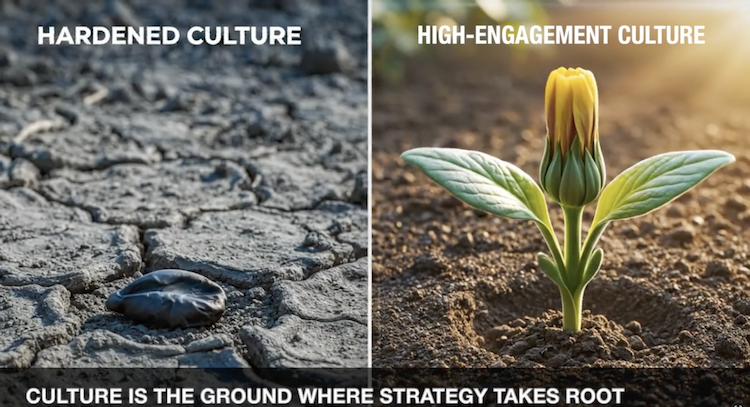
Or think of soil and seeds. A well-designed strategy is the seed. Culture is the soil. Plant even the best seed in hardened, depleted ground and it will not grow. The quality of the seed becomes irrelevant.
Both images point to the same truth. Culture and strategy are not two parallel tracks. Culture is the ground on which strategy either takes root or dies.
The Numbers Every Board Needs to See
This is not philosophical argument. The data is concrete.
Research shows that 70% of mergers and acquisitions fail specifically due to cultural clashes. Not because financial models were flawed. Not because market timing was wrong. Because two organisations, each with deeply ingrained values and ways of working, could not be merged by strategy alone.
One mid-market industrial services acquisition tells the story well. The strategic thesis was strong. The target had a solid regional customer base and excellent margin potential. The financial homework was thorough.
What the acquiring team missed entirely was the culture gap. The target company operated on consensus and relationship-building. The acquirer ran on top-down directive. The friction that followed caused integration milestones to slip. Key managers disengaged. A major client walked out the door.
None of that cultural damage appeared in the strategic financial model. All of it eroded the deal’s value directly.
The same pattern appears in the Multiplicative Value Model, which frames enterprise value creation as a multiplicative equation. Opportunity multiplies by governance, leadership, culture, and environment. Because these factors multiply rather than add, a serious cultural weakness collapses the value of an otherwise excellent strategy. One weak multiplier drags the entire equation down.
Culture is Not “Soft”. It is Operational.
Many boards treat culture as an HR concern. Something the people team manages while serious strategic work happens elsewhere. That framing is expensive.
Johnson and Johnson’s 1982 Tylenol crisis makes the case clearly. The company faced a product tampering emergency and acted decisively. Products were pulled from shelves immediately. CEO James Burke credited the outcome entirely to their culture. Without it, the strategic response would not have been possible.
Yet decades later, that same culture began to erode. Between 2009 and 2010, the company faced severe quality failures, including metal shavings found in product bottles. The erosion of operational culture and ethical values led to heavy regulatory oversight and forced CEO retirement. A historically strong strategy failed because the culture that upheld it had decayed.
The positive case is equally clear. One private sector health provider built its entire strategy around staff and customer participation. Because the culture genuinely rewarded curiosity and engagement, a single request for ideas produced 57,000 calls and 24,000 responses. That cultural openness led to 8,000 tangible improvements, including a 30% efficiency gain in the use of imaging equipment.
The culture did not run alongside the strategy. The culture executed the strategy.
When the Paper Trail Diverges from Reality
A board can approve a strategy. Executives can sign every relevant plan and policy. But what actually happens inside the organisation is determined by the culture, not the documents.
South Africa provides the starkest illustration. An international study of 14 countries found that South Africa had the most sophisticated ethics management systems and formal policies on paper. Simultaneously, it had the worst record for tolerating unethical behaviour in practice.
The rulebook was perfect. The culture overrode it completely.
This is not a problem unique to governments or large institutions. It happens inside businesses every day. Boards set direction. Leaders sign off on plans. And then the actual lived culture – the real behaviours when no one is watching – quietly determines what gets done.
Microsoft’s shift to a cloud-first business model shows what happens when leaders get this right. Board chairman John W. Thompson understood that a bold new direction required a deliberate cultural shift, not just a new plan. The internal culture had to be capable of embracing risk, challenging legacy assumptions, and accepting the ambiguity of leaving a highly successful model behind. The strategy succeeded because the culture was reshaped to carry it.
Three Practical Questions Worth Raising at Your Next Board Session
If you lead a business, or sit on a board, these are worth putting on the table.
Does your culture reward the behaviours your strategy actually requires? If your strategy calls for innovation but the culture punishes failure, no planning document will bridge that contradiction.
When you review strategic progress, do you track cultural indicators alongside financial metrics? Boards that only ask “Are we meeting budget?” build risk-averse cultures. Boards that also ask “What are we learning from failures?” build cultures that can adapt and execute.
When you last assessed your culture, did it go beyond a staff survey? Real cultural assessment requires direct conversation with the people closest to the work, not just aggregated scores.
Closing a culture gap takes sustained effort. In most businesses, the work begins within 90 days of committing to it. Visible leadership behaviour change at the top, honest conversations with frontline teams, and a hard look at what your performance metrics are actually incentivising – these are the starting points.
The Compass and the Destination
The Alice in Wonderland analogy says it well. When Alice asks the Cheshire Cat which way to go, the Cat replies that it does not matter if she does not know where she wants to end up.
Culture is the compass. Strategy is the destination. You cannot reach the destination if the compass is pointing somewhere else.
The most effective B2B boards and executive teams treat culture as a hard operational issue. They build it deliberately. They review it honestly. They align it directly with their strategic goals.
If your business is at a point where culture and strategy need to be brought into alignment – or if you are not certain whether they are – that conversation has real commercial value.
Culture vs Strategy: What’s the Real Difference?
| Dimension | Strategy | Culture |
|---|---|---|
| Definition | The plan for what the organisation wants to achieve. | The actual behaviours and values that determine how work gets done. |
| Ownership | Board and executive leadership set it. | Every person in the organisation lives it. |
| Visibility | Documented in plans, roadmaps, and board papers. | Visible in daily decisions, informal norms, and unwritten rules. |
| Flexibility | Can be revised when market conditions shift. | Takes months or years to change meaningfully. |
| Relationship | Defines the destination. | Determines whether the destination gets reached. |
| Failure Cost | Missed targets, lost market share. | Eroded execution, lost talent, lost clients, collapsed value. |
Director’s FAQ: Culture and Strategy Alignment
How should a board assess whether culture is actually supporting strategy execution?
Look beyond staff surveys. Real assessment requires direct conversation. Sit with frontline teams, customer-facing staff, and operational leaders. Ask: What behaviours does the formal strategy reward? What does the informal culture actually reward? Where do these two diverge? The gaps reveal where culture is either enabling or blocking execution. A board that only reads survey scores misses the lived reality.
What cultural indicators should appear on every board scorecard alongside financial metrics?
Track three things: (1) Does the culture reward the risk-taking or caution your strategy requires? (2) Are the high performers aligned with strategic priorities, or drifting toward legacy business? (3) What percentage of strategic initiatives stall due to resistance or misalignment rather than financial constraints? These indicators signal whether culture will execute or sabotage the plan long before financial results show the damage.
How can a board distinguish between cultural misalignment and pure execution failure?
Ask what actually stopped progress. If teams understood the strategy and had resources but chose not to pursue it – or pursued it differently – culture is the culprit. If teams simply lacked tools, time, or clarity, the problem is execution discipline. The Ports of Auckland case shows the difference: the automation strategy failed not because the plan was bad but because the cultural conditions required to execute it had already eroded. A board diagnoses this by asking frontline teams directly: “Did you understand what was expected? Did you have what you needed to do it? Did you choose not to, or did something else stop you?”
What’s the board’s actual responsibility in closing culture-strategy gaps?
The board cannot fix culture directly. The CEO and leadership team must do that work. But the board must (1) ensure culture assessment happens regularly and honestly, (2) hold the CEO accountable for closing identified gaps, (3) link executive incentives to cultural alignment – not just financial outcomes, and (4) model the behaviours the organisation claims to value. When a board talks about risk management but punishes every failure, or claims to value innovation but rewards only safe plays, the culture follows the board’s actual behaviour, not the board’s stated values.
How often should culture-strategy alignment be reviewed, and what triggers a reassessment?
At minimum, annually as part of strategy review. But trigger an urgent reassessment whenever: (1) the board sees execution shortfalls that financial models do not explain, (2) a major acquisition or structural change occurs – culture becomes visible in integration stress, (3) leadership changes at the top – new leaders bring new cultural expectations that may clash with existing norms, or (4) key talent begins leaving unexpectedly. The pattern in most businesses is that culture gaps are known informally long before they appear in a board paper. A good board asks early and often: “Are we certain the culture will carry this strategy?”
Closing the Loop
The most effective B2B boards do not treat culture as a parallel concern. They treat it as the operational issue it is. They build it deliberately. They review it honestly. They align it directly with strategic goals.
If your board is at a point where culture and strategy need to be brought into alignment – or if you are not certain whether they are – that conversation has real value.
Get in touch. Seerden Board Partners works with boards and CEOs to close the gap between strategic intent and organisational reality. Andrew Seerden brings 30 years of B2B leadership experience, including senior roles at IBM, Compaq, and Hewlett-Packard, plus board governance expertise and a track record helping teams execute through cultural alignment.
To discuss how culture is shaping your strategic outcomes, contact Andrew directly at [email protected].
About Seerden Board Partners
Seerden Board Partners is a governance and board advisory practice supporting B2B business owners and boards to improve governance, strengthen board effectiveness, and align culture with strategy. Andrew Seerden works with a select number of boards and executive teams at any one time, giving each engagement the depth of attention it deserves. Find out more at seerdenboardpartners.com.
This article was originally published on LinkedIn.
View the original discussion here.