How can boards inspire growth without getting lost in operational details?
Boards fail at revenue growth because they focus on tactics instead of strategy. They debate campaign metrics, scrutinise call volumes, and question brochure designs. Then they wonder why growth stalls. The problem is not a lack of attention. It is attention in the wrong place. Strategic board oversight means asking the questions nobody else will ask. It means examining assumptions, testing strategy clarity, and creating space for external challenge. This separates boards that inspire B2B growth from those that suffocate it.
The core problem: oversight versus foresight
Most boards fall into the trap of oversight when they should be practising foresight. They check past results when they should shape future strategy. This matters for business owners considering their first advisory board. It matters equally for executives sitting on boards that feel dysfunctional.
When boards focus on tactics, they ask whether the sales team made enough calls. They scrutinise the efficiency of marketing spend. They review CRM adoption rates. This is oversight masquerading as governance.
Strategic oversight requires different questions entirely. “If we were not doing this now, would we start?” “Are we executing perfectly on the wrong destination?” “Can you summarise our strategy in thirty-five words or less?” That last question acts as a magnet. It aligns the iron filings of your organisation. If your leadership team cannot answer it consistently, you have an alignment problem. No amount of tactical excellence will fix that.
Case 1: The pathology lab disaster
A startup developed a pathology testing kit for women. The product was clever. It was effective. The technology worked brilliantly. The company failed.
Why? They did not know who their customer was. The founders assumed the customer was the woman using the kit. Logical. Obvious. Wrong.
The actual purchaser was the pathology lab. And labs operated under a government payment model based on sample volume, not accuracy or quality. The kit’s unique selling point was reducing false samples. Fewer errors. Better patient outcomes. But fewer samples meant less revenue for the labs. The company built an excellent product that actively harmed their buyer’s business model.
Board governance demands we challenge assumptions about customers. “Who is actually the customer?” is a question that sounds simple. It is anything but. Do not assume the end-user is the buyer. Do not assume you know why the competition is winning. Do not assume customer needs match your current business model.
Case 2: The Ogilvy China transformation
Scott Kronick describes how external advisory board members transformed one of the world’s leading agencies. The CEO of Ogilvy China realised his executives were too inward-looking. They were drinking their own Kool-Aid.
He established an advisory board with three unusual members. A Chinese professor. A former diplomat. An economist. Their job was simple: tell the leadership team what was actually happening in China.
One advisor made a suggestion that changed everything. Stop thinking like a PR firm. Start thinking about “public branding” for cities. That single insight, born from external challenge, opened a massive new revenue stream. They began advising cities and countries, not just companies.
This is what executive advisory delivers. Fresh perspectives. Clean challenge. The ability to break echo chambers before they become coffins. The uncomfortable questions here matter: “Are we looking for validation of our current ideas, or are we willing to pay for constructive challenge?” “What conversation are we avoiding right now regarding our market position?” “What is the area, if improved, that would give us the greatest return on time, energy, and dollars invested?”
Case 3: The skeet shoot that killed growth
Not all board dysfunction is about ignorance. Sometimes experienced voices actively destroy opportunities. A company wanted to expand from Canada into Michigan. Solid logic. Geographic proximity. Market potential identified.
A long-serving director shut it down immediately. Sarcasm first. “What do we know about Americans?” Age and experience weaponised against fresh thinking.
Years passed. Management returned with new data. Fresh analysis. Updated market research. The director shot it down again. “We talked about this already. We agreed it was not worthwhile.” They had agreed nothing of the sort. One dominant voice had killed the idea. The chair failed to intervene. Bias, not data, won the day.
Board governance requires vigilance against this pattern. “Are we rejecting this opportunity based on current data, or historical scar tissue?” “Do we have the right scout looking for opportunities, or are we only relying on lookouts spotting risks?” B2B growth requires boards that balance caution with ambition. Scar tissue from past failures should inform decisions, not dictate them.
Case 4: The receptionist who saved retention
An organisation set a target: improve member retention from 89% to 92%. Three percentage points. Significant revenue impact. The CEO did something unusual. Instead of just pushing the sales team, he asked the receptionist what she could do to help.
She revealed an insight no one expected. Every morning, she listened to the answering machine. She heard resignation messages and processed them. “I resign them,” she said. That was her job.
Once she understood the strategic goal, she changed her approach. When she heard a resignation, she called the member back and tried to save the relationship. Retention hit 95%.
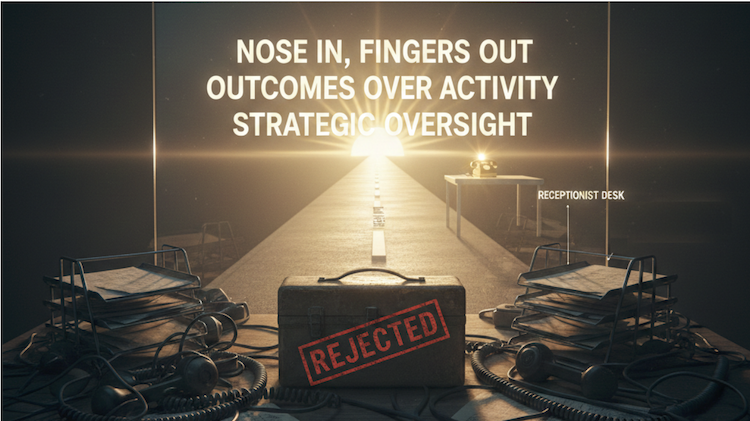
The board set the strategic target. The CEO found the solution. The board never tried to write the script for the front desk. This is “nose in, fingers out” governance in action. The board cared about the destination. They left the driving to those closest to the road.
Case 5: The energy tech exit strategy
A tech subsidiary of an energy company was performing modestly. Nothing special. Comfortable mediocrity. The board and management agreed on a specific sales strategy: acquire smaller players, annoy the number one and number two market leaders, eventually force them to buy the company. They executed this strategy over four years. Single-minded focus. Clear direction. No tactical debates about quarterly performance.
They exited at five times the valuation. The board never got into the weeds of daily tech operations. They focused entirely on the strategic outcome. Every management move was assessed against one question: does this advance our exit narrative?
Tactical versus strategic board focus
| Tactical Board Focus | Strategic Board Focus |
|---|---|
| Debates campaign metrics and brochure designs | Challenges core business assumptions |
| Reviews activity: calls made, spend efficiency, adoption rates | Examines outcomes: growth trajectory, market fit, strategic clarity |
| Looks in the rear-view mirror at past results | Looks through the windshield at future opportunities |
| Approves or debates routine management decisions | Asks uncomfortable questions about destination and direction |
| Validates the current strategy | Challenges and tests the current strategy |
| Relies on internal perspectives only | Brings external challenge and fresh perspectives |
| Rejects opportunities based on historical scar tissue | Uses past failures to inform, not dictate, decisions |
| Gets into the operational weeds of execution | Sets strategic direction and stays out of the operational details |
The questions that matter
Revenue leadership in the boardroom is not about knowing marketing better than your CMO. It is not about second-guessing your sales director. It is about asking questions that nobody else will ask.
“What is the central idea or driving force behind our current sales push?” “What is currently impossible to do that, if it were possible, would change everything?” “If you were competing against our company, what would you do?” “If you were hired to consult with our company, what would you advise?”
These are Level 3 and Level 4 questions. They demand complex thinking. They expose strategic trade-offs. They force honesty. Level 1 and Level 2 questions are routine approvals and binary choices. Any manager can handle those. The board exists for something more valuable.
What this means for your business
Whether you are a business owner without any board structure, or an executive sensing dysfunction in your current governance, the path forward is the same.
Stop asking about activity. Start asking about outcomes. Stop looking in the rear-view mirror. Start looking through the windshield. Build an advisory board that brings constructive challenge, not comfortable validation. Invite people who will tell you when you are heading for the wrong destination.
The cost of poor strategic oversight is not measured in meeting hours. It is measured in missed opportunities, failed expansions, and products built for customers who never existed.
Director’s FAQ
What is the difference between tactical and strategic board oversight?
Tactical oversight focuses on past performance: activity metrics, campaign efficiency, and operational details. Strategic oversight focuses on future direction: challenging assumptions, testing strategy clarity, and examining whether the business is executing on the right destination. Tactical boards ask “Did we do it well?” Strategic boards ask “Should we be doing this at all?”
What are Level 3 and Level 4 board questions?
Level 1 and Level 2 questions are routine approvals and binary yes-or-no choices. Any manager can handle those. Level 3 and Level 4 questions demand complex thinking, expose strategic trade-offs, and force honesty. Examples: “If we were not doing this now, would we start?” and “What is currently impossible to do that, if it were possible, would change everything?”
Why do boards need external advisory perspectives?
Internal teams, no matter how talented, develop groupthink. External advisors break echo chambers before they become coffins. They bring fresh eyes to assumptions nobody else questions. They can tell you what is actually happening in your market, not what you want to hear. The cost of this external challenge is far lower than the cost of missed opportunities and strategic blind spots.
How can boards avoid rejecting good opportunities based on past failures?
Distinguish between data-driven rejection and bias-driven rejection. Ask: “Are we rejecting this opportunity based on current data, or historical scar tissue?” Scar tissue from past failures should inform decisions, not dictate them. Balance caution with ambition. Do you have enough scouts looking for new opportunities, or only lookouts spotting risks?
What does “nose in, fingers out” governance mean?
The board cares deeply about the strategic destination and outcome. The board does not write the script for how the team gets there. The board sets the target for retention improvement; the board does not tell the receptionist how to handle resignation calls. This separation allows the board to drive strategic accountability without micromanaging operational execution.
Ready to establish a board that asks better questions?
I help B2B businesses establish advisory boards that deliver strategic oversight without operational interference. Whether you are building your first advisory structure or fixing a dysfunctional one, the conversation starts with one question: what outcome do you actually want?
Contact me at [email protected] to discuss how advisory support can help your board focus on strategy.
Andrew Seerden is a trusted board and governance advisor with 30+ years of senior leadership at IBM, Compaq, and Hewlett-Packard. He works with B2B business owners and executives to establish effective advisory boards, improve governance, and drive strategic growth.
This article was originally published on LinkedIn.
View the original discussion here.